 calledges.com
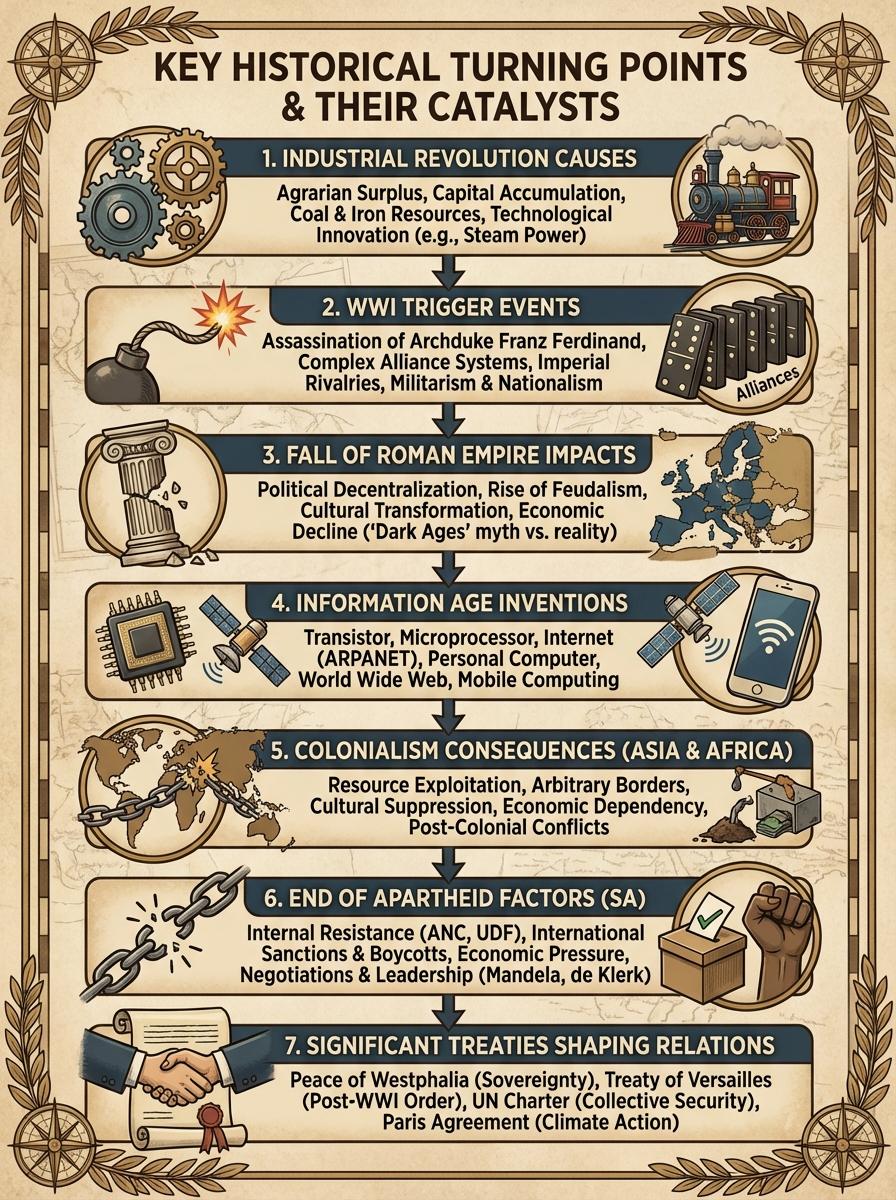
Illustration: History's Essential Infographic
Major Causes of the Industrial Revolution
The Industrial Revolution was primarily caused by advancements in agricultural productivity, which freed up labor for industrial work. Innovations such as the steam engine drastically improved manufacturing and transportation. Additionally, the availability of natural resources and capital investment fueled rapid industrial growth.
Events That Triggered World War I
The immediate trigger for World War I was the assassination of Archduke Franz Ferdinand of Austria-Hungary. This event ignited existing tensions between major European powers through a complex web of alliances. Militarism, nationalism, and imperial rivalries further escalated the conflict into a global war.
Impacts of the Fall of the Roman Empire on Europe
The fall of the Roman Empire led to the decentralization of political power and the rise of feudalism in Europe. It caused economic decline and reduced urbanization, disrupting trade networks. This era also paved the way for the spread of Christianity and the eventual formation of medieval European kingdoms.
Inventions Most Influencing the Information Age
The Information Age has been shaped by inventions like the personal computer, the internet, and mobile communication devices. These technologies revolutionized how information is created, stored, and shared globally. They enabled unprecedented connectivity and access to knowledge across all sectors.
Main Consequences of Colonialism on Asia and Africa
Colonialism resulted in cultural disruption and economic exploitation in Asia and Africa. It imposed new political borders and governance structures, often ignoring indigenous systems. Despite infrastructure development, colonial rule frequently led to long-term social inequalities and conflicts.
Factors Leading to the End of Apartheid in South Africa
The end of apartheid was driven by internal resistance movements and increasing international pressure. Economic sanctions and diplomatic isolation weakened the apartheid government. Negotiations between leaders, including Nelson Mandela, paved the way for democratic reforms.
Treaties That Significantly Shaped International Relations
Key treaties like the Treaty of Westphalia, the Treaty of Versailles, and the United Nations Charter have influenced modern diplomacy. These agreements established principles of sovereignty, peace enforcement, and international cooperation. They continue to underpin global political order and conflict resolution.