 calledges.com
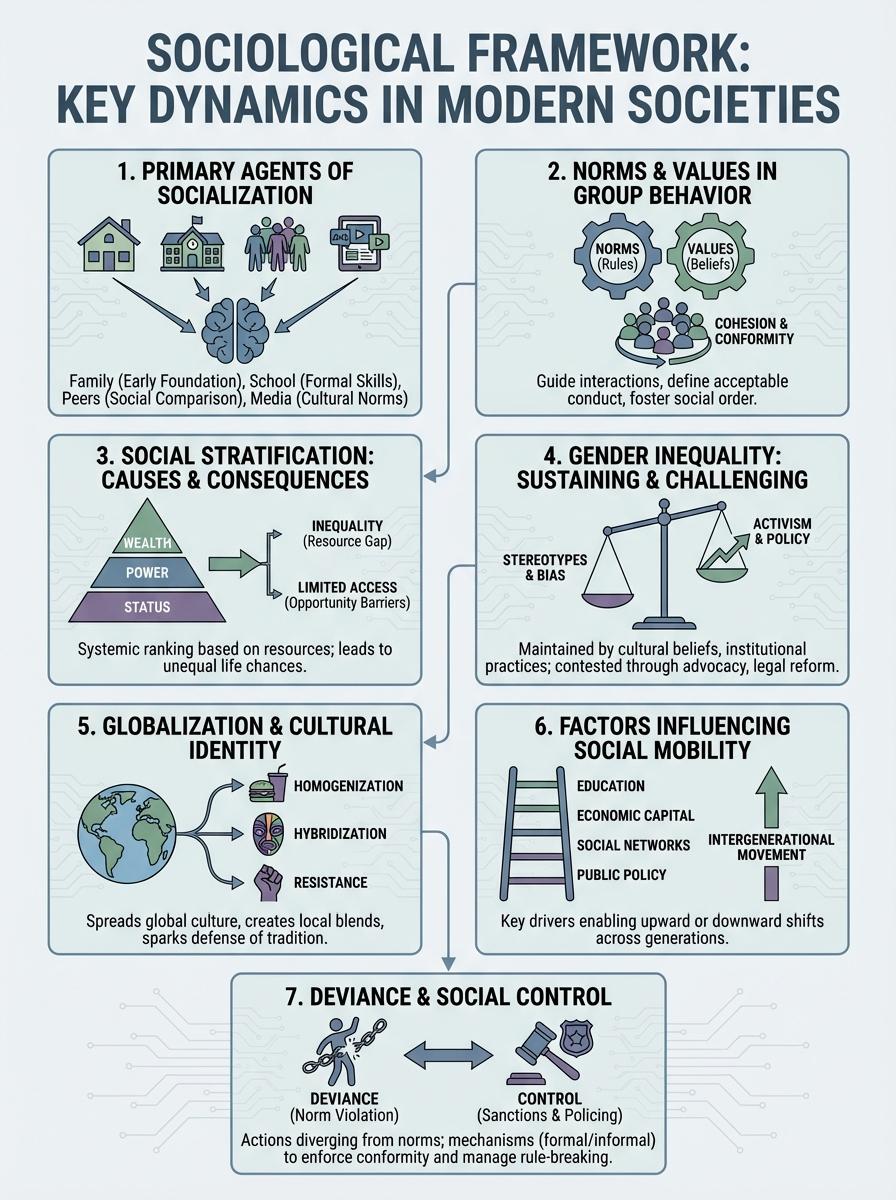
Illustration: Sociology's Essential Infographic
Primary Agents of Socialization in Modern Societies
The family remains the foundational agent of socialization, instilling core values and norms from early childhood. Educational institutions play a crucial role in the transmission of societal knowledge and social skills. Peer groups and media increasingly influence individual behaviors and perceptions in contemporary contexts.
Roles of Norms and Values in Shaping Group Behavior
Norms provide unwritten rules that guide acceptable behavior within societies. Values serve as overarching principles that influence individual and collective decisions. Together, they foster social cohesion and regulate interactions in groups, promoting harmony and order.
Causes and Consequences of Social Stratification
Social stratification arises from disparities in wealth, power, and status within society. It often results in unequal access to resources and opportunities, perpetuating social inequality. Consequences include restricted social mobility and systemic discrimination for marginalized groups.
Mechanisms Sustaining and Challenging Gender Inequality
Patriarchal structures and cultural norms commonly reinforce gender inequality by limiting roles and opportunities for women. Social movements and policy reforms challenge these inequities by advocating for equal rights and representation. Education and awareness campaigns further promote gender equity.
Impacts of Globalization on Cultural Identity
Globalization facilitates cultural exchange, which can lead to both cultural homogenization and diversification. It challenges traditional identities while also enabling the spread of new cultural forms. The interaction between global and local cultures shapes evolving cultural identities.
Factors Influencing Social Mobility Across Generations
Education is a key factor enabling upward social mobility by providing skills and qualifications. Economic conditions and family background also heavily influence opportunities available to individuals. Social policies aimed at reducing inequality can facilitate greater mobility.
Key Features of Deviance and Social Control in Various Societies
Deviance involves behaviors that violate societal norms and expectations. Social control mechanisms, such as laws and informal sanctions, are designed to maintain order and discourage deviance. The nature of deviance and control varies across cultures depending on social values and institutions.